Unschool Academy of Art, Science & Business
A Model School
Begin with the Student.
What might a school become if we designed it around the people within it?
USASB is a fully developed Model School: a concrete example of an educational community designed around human beings and their continuing becoming.
USASB is not currently an operating school and does not enroll students. This website presents the model from within, allowing visitors to explore how its students, teachers, families, learning, time, places, governance, traditions, and responsibilities fit together as parts of one educational community.
Explore USASB
About the Model
A School Begins with People
Before we decide what students should study, how teachers should teach, how the day should be scheduled, what a campus should contain, or how a school should be governed, we can begin with more fundamental questions:
Who is this person?
Who is this person becoming?
How can education faithfully accompany that continuing journey?
USASB begins there.
Education is the stewardship of human possibility. Knowledge matters. Skill matters. Discipline, creativity, responsibility, excellence, and achievement matter. But each exists in service of people whose lives are still unfolding.
Purpose therefore comes before structure.
USASB asks what might happen if we designed a school outward from that understanding.
Welcome to USASB
At USASB, a school is understood first as a community.
Students and teachers know one another over time. Students belong to Cohorts that provide continuity, relationships, shared history, and a dependable home within the larger community. Teachers accompany students as they learn while continuing their own work as scholars, artists, practitioners, mentors, collaborators, and learners.
Families remain primary stewards in the lives of their children and belong within the wider educational community. Their knowledge, languages, traditions, experiences, relationships, and ways of seeing the world enrich the life of the school.
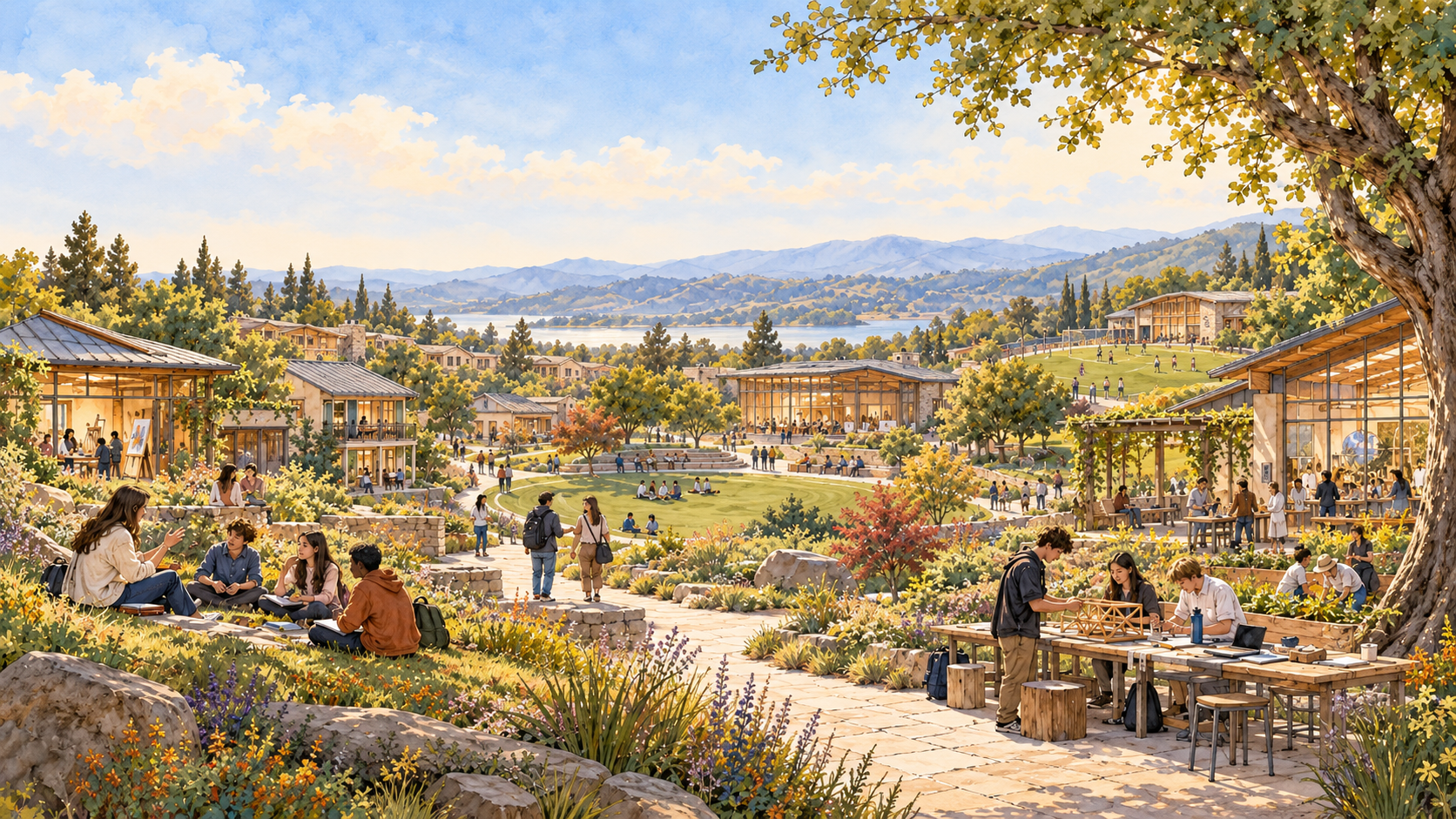
Across the campus, people gather to read, investigate, make, rehearse, discuss, calculate, write, build, practice, experiment, perform, solve problems, create businesses, tend gardens, prepare food, play, reflect, and contribute useful work.
Some learning begins with a student question. Some begins with a teacher. Some grows from a shared responsibility, a problem worth solving, a skill worth mastering, a work of art worth creating, or something the community needs.
Learning takes many forms because human beings do.
Meet the People
Belonging and Possibility
Every student belongs to a Cohort.
A Cohort grows together over years, accompanied by teachers who have time to know the students well. Its Homeroom is both a home and a workplace: a familiar place for conversation, sustained work, projects, individual study, collaboration, celebration, and the ordinary life through which relationships deepen.
But students do not spend their lives inside one room or only among people their own age.
The wider USASB community opens toward mixed-age learning, specialized study, projects, individual instruction, performances, workshops, laboratories, gardens, community experiences, and three broad Domains: Art, Science, and Business.
A student may be experienced in one setting and a beginner in another. Someone who once watched may eventually lead. Someone who first needed close guidance may later earn greater independence and help another person learn.
Belonging provides a place from which to grow.
Explore Cohorts
Visit the Domains
Learning Has Both Foundations and Pathways
Beginning with the student does not mean leaving students entirely to themselves, nor does it require every student to follow the same educational path.
USASB holds these realities together.
Students encounter shared foundations that help them participate thoughtfully and capably in human life. At the same time, they develop individual pathways shaped by their interests, abilities, questions, commitments, circumstances, emerging purposes, and growing responsibilities.
Learning may take place through sustained projects, individual instruction, Cohort conversations, Domain work, practice, research, collaboration, independent study, play, performance, community experiences, mentorship, and meaningful work.
Choice matters. So do guidance, challenge, practice, knowledge, responsibility, and the wisdom of people who know more than we do.
Education is neither complete control nor complete absence.
It is accompaniment.
Explore Learning at USASB
Time Is Part of the Design
The day at USASB has rhythm without requiring every person to do the same thing at the same moment.
Morning Cohort life provides continuity and belonging. A shared meal creates time for nourishment, conversation, rest, and community. Afternoons open more widely toward Domains, mixed-age relationships, specialized study, projects, individual pathways, and experiences beyond the campus.
Teachers also have a different relationship with time.
Each teacher ordinarily spends one four-hour portion of the day working directly with students and another four-hour portion in stewardship: preparing, studying, creating, collaborating, understanding students, developing learning opportunities, maintaining professional practice, contributing to the community, and sustaining the work that good teaching requires.
The schedule serves the people within it.
The people do not exist to serve the schedule.
Experience a Day at USASB
A Community Has a Home
Place matters.
USASB is imagined as a campus where buildings, pathways, gardens, workshops, studios, laboratories, performance spaces, athletic areas, kitchens, libraries, gathering places, and natural spaces contribute to the educational life of the community.
Each Cohort has a place it calls home. Art, Science, and Business have places where specialized work can grow. The entire community has places to gather, eat, deliberate, celebrate, perform, welcome visitors, and simply spend time together.
Learning also extends beyond the campus.
Libraries, businesses, museums, universities, parks, farms, laboratories, theaters, cultural institutions, natural areas, homes, neighborhoods, workshops, civic organizations, and other parts of the surrounding community become part of the larger learning ecology.
The campus is a home from which students can venture outward and to which they can return.
Walk the Campus
Explore the Wider Community
Freedom Grows with Responsibility
Students at USASB are not merely recipients of decisions made by other people.
They are members of a community.
Through the Assembly and other forms of shared governance, students and teachers consider questions, make decisions, hear proposals, address concerns, establish expectations, celebrate accomplishments, and accept responsibility for the community they share.
Freedom develops alongside judgment, readiness, trust, and responsibility.
A student who wishes to use a particular tool, assume a particular role, enter a specialized workspace, or work with greater independence may demonstrate readiness through certification. The question is not simply, How old are you? It is also, What are you ready to do, and what responsibility are you prepared to accept?
Increasing freedom and increasing responsibility belong together.
Visit the Assembly
Explore Certification & Readiness
Read the Constitution
Education Is About More Than Finishing School
Students are continually becoming.
USASB therefore understands graduation as more than the completion of a prescribed number of years, courses, credits, or requirements.
Over time, students build lives of learning, relationships, experiences, responsibilities, accomplishments, questions, interests, contributions, and increasingly purposeful work. Portfolios help make that development visible. Teachers, families, mentors, and other members of the community accompany students as they consider where they have been and what might come next.
Graduation recognizes both completion and continuation.
The student leaves one educational community without leaving education behind.
Explore Graduation & Portfolio
Explore USASB
The best way to understand the model is to enter it.
Meet the Students → Enter a Cohort → Visit a Domain → Spend a Day at USASB → Meet the Teachers → Walk the Campus → Attend Assembly → Explore a Certification → Examine a Student Portfolio → Read the Constitution
Each part reveals something about the others.
The Cohort affects learning. The schedule affects teachers. Teacher time affects individual pathways. The campus affects relationships. Governance affects responsibility. Certification affects freedom. Families connect school life with a larger human life.
Educational design is never only about one structure.
It is about the relationships among them.
Explore the Model
One Possible School
USASB is not presented as the one correct design for education.
Different people, places, cultures, communities, purposes, and circumstances can lead thoughtful designers toward different choices.
USASB exists because educational ideas become easier to examine when they become concrete. It asks us to move beyond saying that education should honor students, support teachers, value families, encourage responsibility, provide meaningful learning, and build community.
It asks another question:
What would we actually design if we meant it?
USASB is one possible answer.
Begin with the Student
The educational philosophy underlying USASB is developed more fully in Begin with the Student: Designing Education Around Human Becoming by Dennis Frayne.
The book begins with questions about the human person, learning, teaching, knowledge, purpose, community, freedom, responsibility, time, and place. It then moves from philosophy toward design.
USASB gives one such design a name, a campus, a daily rhythm, a community, a Constitution, and a way of life.
The book explores the reasoning.
This website invites you to explore the school.
Learn About Begin with the Student
About the USASB Project
USASB
Unschool Academy of Art, Science & Business
A Model School
A school is more than a collection of classrooms, schedules, subjects, policies, and programs.
It is a community of people whose lives are still unfolding.
Begin with them.